
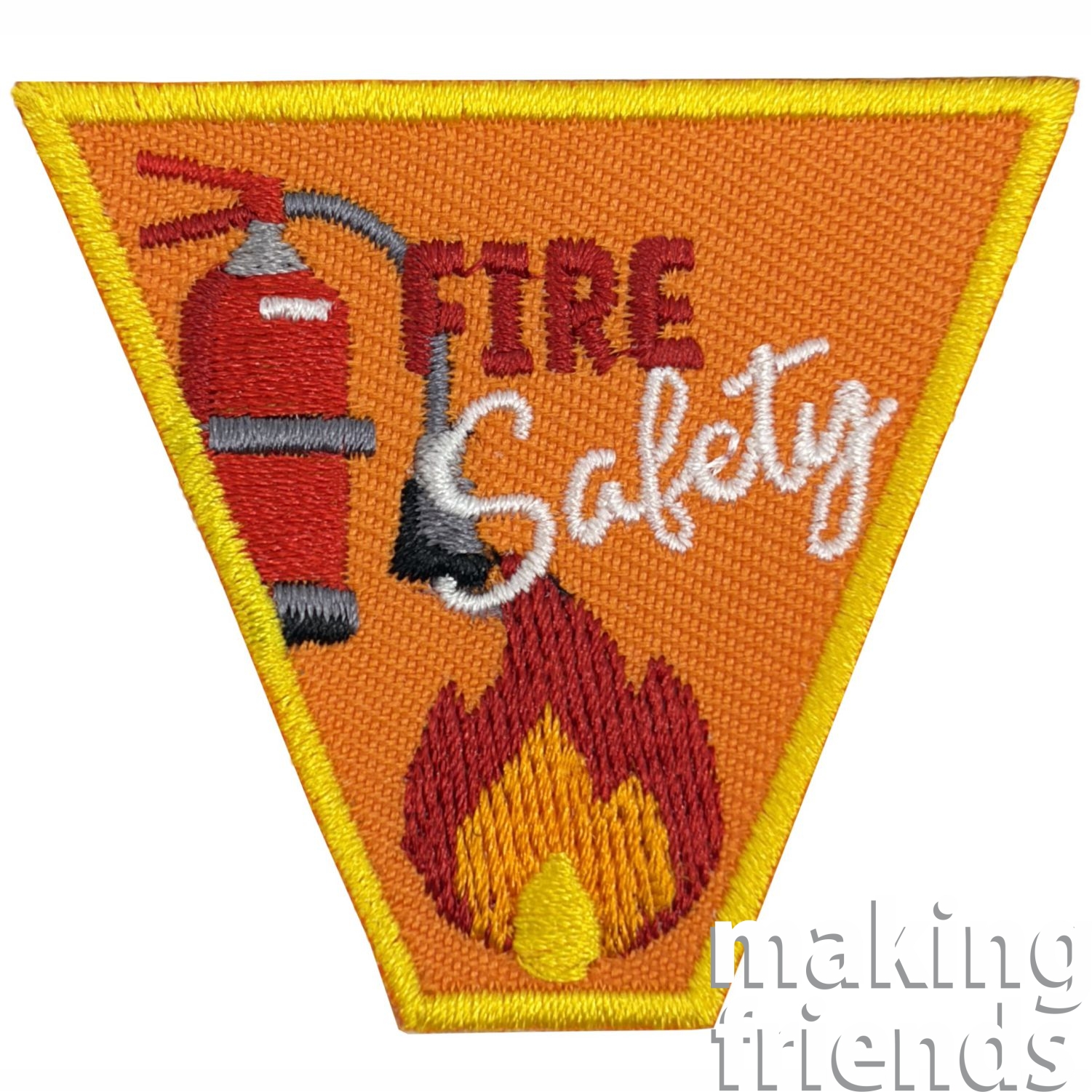
Fire Safety Patch Program®
Original price was: $0.99.$0.75Current price is: $0.75.
 This Fire Safety Patch Program® is an interactive curriculum designed to teach scouts of all ages vital fire prevention and emergency survival skills. Through age-appropriate activities, younger scouts practice basic rules like “Stop, Drop, and Roll,” while older scouts master advanced skills such as home safety audits and fire extinguisher operation.
It is part of our Safety First Patch Program® group.
Out of stock
Iron on! 2″ Embroidered Patch.

Suggestions for Younger Girl Scouts to Earn The Fire Safety Patch Program®
Earning this patch helps younger children understand the basics of fire prevention, what to do in an emergency, and how to stay calm and safe around fire hazards.
1. Watch this video about fire safety.
An educational video designed to teach children basic fire prevention and what to do in case of a house fire or a fire at school.
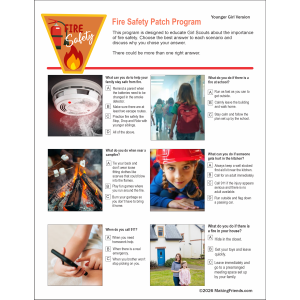
2. Complete the Fire Safety Worksheet
Print the fire safety worksheet from your order confirmation or download it from your account.
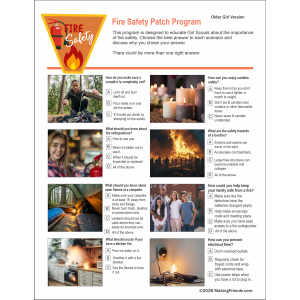
Read through each scenario with your girls and discuss the options provided. There may be more than one correct answer. Encourage your girls to come up with their own responses.
3. Master the “Stop, Drop, and Roll” Rule
The Rule: If your clothes ever catch on fire, do not run! Running makes the fire grow. Stop immediately, drop to the ground, cover your face with your hands, and roll back and forth until the fire is out.
Activity: Practice the exact motions in an open space. Have a leader yell “Stop, Drop, and Roll!” and have the children practice dropping down instantly and rolling safely.
4. Know Your Emergency Exit Plan: “Two Ways Out”
The Rule: Every room in a house or meeting space should have two ways to get out in case one is blocked by fire or smoke.
Activity: Walk around your meeting space or home. Identify the main door and a secondary exit (like a window or back door). Practice walking calmly to both exits.
5. Meet at the Safety Spot
The Rule: Once you are outside a burning building, you must stay outside and gather at a pre-planned family or troop meeting spot (like a specific tree, mailbox, or neighbor’s porch).
Activity: Take the group outside to designate a “Safe Meeting Spot.” Practice exiting the building and gathering at that exact spot. Once there, practice doing a quick “Headcount Check!”
Suggestions for Older Girl Scouts to Earn The Fire Safety Patch Program®
For older scouts, fire safety requires advanced situational awareness, home hazard mitigation, emergency coordination, and understanding outdoor/campfire management.
1. Watch this video about escaping a house fire.
This video uses a live, simulated smoke house to show how quickly a modern home fills with toxic smoke and demonstrates real-time escape tactics.
2. Complete the Fire Safety Worksheet
Print the fire safety worksheet from your order confirmation or download it from your account.
Read through each scenario with your girls and discuss the options provided. There may be more than one correct answer. Encourage your girls to come up with their own responses.
3. Conduct a Home Fire Hazard Inspection
- The Rule: The best way to survive a fire is to prevent it from ever starting.
- Activity: Download or create a home safety audit checklist. Inspect a home or meeting facility. Check the dates on smoke and carbon monoxide detectors, ensure testing buttons work, and verify that fire extinguishers are fully charged and unexpired.
4. Create a Formal Family Escape & Communication Plan
- The Rule: In a real emergency, panic sets in if there is no clear plan. Everyone in the household needs to know their role.
- Activity: Draw a grid map of your home showing all doors, windows, and two escape routes from each room. Choose an outside meeting place a safe distance from the home. Write down emergency contact numbers and assign who is responsible for helping pets or younger siblings.
5. Practice the Smoke Escape Crawl
- The Rule: Smoke is toxic and rises. The cleanest, coolest air during a structure fire is always closest to the floor.
- Activity: Create a mock smoke scenario using a sheet or low obstacles. Practice crawling on hands and knees (“Get low and go”) beneath the “smoke line.” Practice feeling closed doors with the back of your hand to check for heat before opening them.
6. Learn the Fire Extinguisher “P.A.S.S.” Method
- The Rule: Only attempt to fight a small, contained fire if you have a clear escape route behind you.
- Activity: Study the different types of fire extinguishers (Class A, B, C). Practice the P.A.S.S. acronym using an empty or training extinguisher:
- Pull the pin.
- Aim low at the base of the fire.
- Squeeze the lever.
- Sweep from side to side.
7. Master Campfire Safety & Extinguishment
- The Rule: An outdoor fire is not officially out until it is cold to the touch. Leftover embers can easily spark a wildfire.
- Activity: Learn how to clear a 10-foot safety circle around a campfire pit, away from overhanging branches and tents. Practice the proper way to extinguish a fire: Drown it with water, Stir the ashes with a shovel, Drown it again, and carefully test the heat with the back of your hand.






Reviews
There are no reviews yet.