Weather Safety Patch Program®
Iron on! 2″ Embroidered Patch.
The Weather Safety Patch Program® is designed to teach scouts how to read nature’s warning signs, understand rapid atmospheric changes, and master emergency preparedness. From younger girls practicing the “lightning crouch” to older scouts navigating cell-service dead zones with wilderness first aid, this program builds the ultimate safety mentality.
- Includes targeted, age-appropriate downloadable worksheets for both Younger and Older Girl Scouts.
- Perfect for your next camping, hiking, or outdoor adventure meeting!

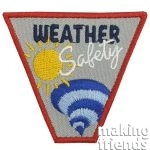
Suggestions for Younger Girl Scouts to Earn The Weather Safety Patch Program®
Earning this patch helps younger girls understand different types of weather, learn how to read nature’s warning signs, and know exactly what to do to stay safe and calm during a storm.
1. Watch this video about staying safe outdoors.
knowing the difference between a sunny day and a changing sky, and always listening to a grown-up when it’s time to head indoors.
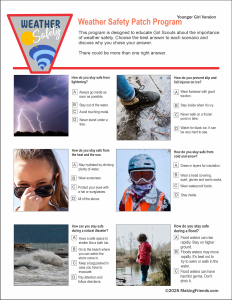
2. Complete the Weather Safety Worksheet
Print the weather safety worksheet from your order confirmation or download it from your account.
Read through each scenario with your girls and discuss the options provided. There may be more than one correct answer. Encourage your girls to come up with their own responses.
3. The “When Thunder Roars, Go Indoors” Rule
Encourage your girls to think about what they would do if they heard thunder while playing at the park or if the wind started blowing very hard.
Discuss the importance of checking your surroundings when outside. How do you know a storm is coming? What hidden dangers come with lightning and rain? Practice saying out loud: “When thunder roars, I go indoors!” and remember that a sturdy building or a car is the safest place to be.
4. Packing a “Just-In-Case” Daypack
Use a small backpack to demonstrate how to prepare for unexpected changing weather during an outdoor activity. Discuss essential items to bring (a light rain poncho, an extra layer, sun protection, and a whistle). Practice packing it up and ensuring it fits comfortably.
5. Learn and Practice How to Handle Unexpected Weather Situations
The Safe Crouch (If Caught Outside): Practice the “lightning crouch” just in case they are ever stuck in an open area with no shelter. Roleplay dropping to the knees, balling up low to the ground, tucking the head, and covering the ears to minimize contact with the ground.
“Turn Around, Don’t Drown”: Practice what to do if heavy rain causes flooding on a path or sidewalk. Never walk through moving water, as it can be deceptively deep and strong. Practice the rule of stopping, turning around, and finding a safe, high path while alerting an adult.
Roleplay Scenarios: In pairs or a troop setting, safely roleplay real-world scenarios. Examples: You are swimming and hear a low rumble of thunder; a sudden heavy downpour starts during a backyard game; the sky turns an unusual dark green color while you are out on a walk.
Suggestions for Older Girl Scouts to Earn The Weather Safety Patch Program®
For older scouts, weather safety requires reading wilderness weather signs, how topography affects storms (like flash floods in canyons or lightning risks on ridgelines), and how to monitor forecasts before heading into cell-service dead zones.
1. Watch this video about staying safe outdoors.
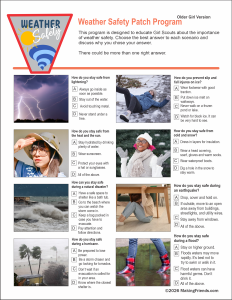
2. Complete the Weather Safety Worksheet
Print the weather safety worksheet from your order confirmation or download it from your account.
Read through each scenario with your girls and discuss the options provided. There may be more than one correct answer. Encourage your girls to come up with their own responses.
3. The Science of Atmospheric Danger (The Rapid Shift)
Dangerous weather shifts aren’t always slow—they can be rapid, catching hikers or campers completely off guard. Conditions like microbursts, flash floods, or sudden lightning strikes require immediate, decisive action.
When you are outdoors, pay close attention if you notice these environmental signals:
- The Temperature Drop: A sudden, sharp plunge in temperature and a swift shift in wind direction often signal an approaching gust front or severe thunderstorm cell.
- The Anvil Cloud: A tall, cumulonimbus cloud flattening out at the top indicates a mature, high-energy storm system capable of lightning and severe wind moving into your area.
- The Flash Flood Trigger: Heavy rain upstream can cause river levels miles away to rise rapidly without warning. Watch for water turning muddy, carrying sudden debris, or rising along the banks.
The Safety Mentality: Older scouts are often tempted to ignore early warning signs to finish a trail, reach a summit, or avoid delaying a group trip. Your safety and your group’s lives will always be more important than sticking to an itinerary. If a weather front looks dangerous or conditions exceed your gear’s limits, turn back or seek shelter immediately.
4. Master Emergency Signaling & Navigation
- The Rule: Cell service fails during severe weather, in dense woods, or in deep canyons. You must know how to signal for help without a phone.
- Activity: Learn the universal outdoor distress signals (three whistle blasts, three flashes of a flashlight, or three bright markers placed in a triangle). Practice using a physical compass to orient yourself toward a safety checkpoint if visibility drops due to heavy rain, fog, or snow.
5. Master Emergency Signaling & Navigation
- The Rule: Cell service fails in dense woods or canyons. You must know how to signal for help without a phone.
- Activity: Learn the universal outdoor distress signals (three whistle blasts, three flashes of a flashlight, or three bright markers placed in a triangle). Practice using a physical compass to orient yourself toward a safety checkpoint.
6. Recognize Extreme Temperature Hazards
- The Rule: Know how to identify, prevent, and treat common weather-related ailments like dehydration, heat exhaustion, and hypothermia.
- Activity: Create a mock outdoor emergency scenario. Have the girls practice recognizing the early warning signs of heat stroke (hot, dry skin or confusion) versus hypothermia (uncontrolled shivering, slurred speech). Practice pitching an emergency bivvy or space blanket to protect someone from extreme wind and wet weather.
7. Wilderness First Aid & Environmental Hazards
- The Rule: Know how to identify, prevent, and treat common outdoor ailments like dehydration, heat exhaustion, hypothermia, and tick bites.
- Activity: Create a mock outdoor emergency scenario. Have the girls practice checking each other for ticks (focusing on hidden spots like ankles and behind ears), treating a simulated blister, and recognizing the early warning signs of heat stroke.
8. Create a Weather-Ready Emergency Trip Plan
- The Rule: If severe weather traps you, people at home need to know exactly where you are to send search and rescue.
- Activity: Before heading out on a hike, fill out a formal trail plan detailing your group’s exact route, your expected start and return times, and emergency backup routes in case of trail flooding. Leave this document with a trusted adult at home before setting foot on the trail.